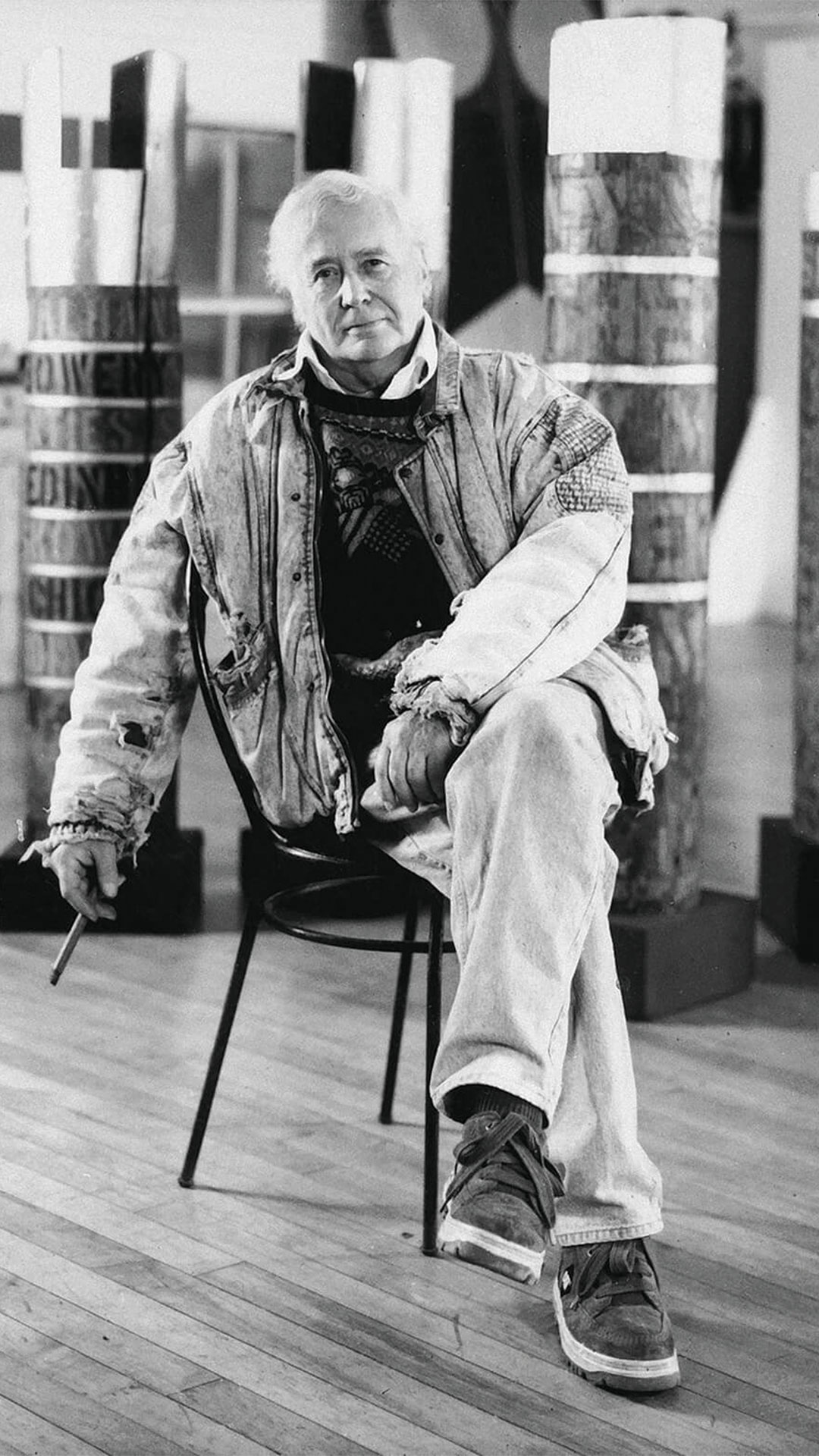

Robert Indiana
Robert Indiana (b. 1928, New Castle, Indiana – d. 2018, Vinalhaven, Maine) was one of the most influential figures in American art from the 1960s onward. A leading voice in the development of Pop art, assemblage, and hard-edge painting, Indiana created a visual language that fused abstraction, typography, and cultural symbolism, laying the groundwork for generations of artists working with text and identity.
Born Robert Clark, Indiana’s early years were marked by movement and reinvention. After serving in the U.S. Air Force, he pursued formal training at the Art Institute of Chicago, the Skowhegan School of Sculpture and Painting, and the Edinburgh College of Art. In 1956, he relocated to New York City, where a burgeoning downtown arts scene awaited. Two years later, he moved into a loft at 25 Coenties Slip, a historic shipping district that became home to a circle of avant-garde artists including Ellsworth Kelly, Agnes Martin, and James Rosenquist.
Inspired by the raw industrial environment, Indiana began creating sculptural assemblages from salvaged wood, metal, and maritime remnants—works he called “herms,” referencing ancient boundary markers. His discovery of 19th-century brass stencils led to the incorporation of numbers and short, emotionally charged words into his practice, laying the foundation for his most iconic works.
Indiana’s breakout came in the early 1960s with exhibitions at the Martha Jackson Gallery, MoMA, and Sidney Janis Gallery, and with the acquisition of The American Dream I (1960–61) by MoMA. His best-known work, LOVE (first realized as a print in 1965), became an enduring symbol of American culture—appearing in paintings, sculptures, and even U.S. postage stamps.
While aligned with Pop, Indiana distinguished himself by addressing social justice, spirituality, and American history, drawing from literary figures like Herman Melville and political symbols like the peace sign. His 1964 commission for the New York World’s Fair (EAT) and his collaboration with Andy Warhol on the film Eat reflected both his conceptual agility and his visual wit.
Indiana’s works reside in the permanent collections of the Museum of Modern Art, Centre Pompidou, Whitney Museum of American Art, and countless public spaces worldwide. He spent his later years working from his studio on Vinalhaven Island, Maine, continuing to refine his unique blend of visual poetry and cultural critique.
Awards & Recognitions
- Acquisition of The American Dream I - Museum of Modern Art, New York (1961)
- Design Commission for New York World’s Fair - Commissioned by architect Philip Johnson for the New York State Pavilion (1964)
- US Postal Stamp Featuring LOVE - Issued by the United States Postal Service, cementing the work’s iconic status (1973)
Notable Exhibitions
- Art of Assemblage (Museum of Modern Art, New York, USA, 1961)
- The American Dream, I (Acquired and exhibited by MoMA, New York, USA, 1961)
- Galerie Schmela Solo Exhibition (Düsseldorf, Germany, 1966)