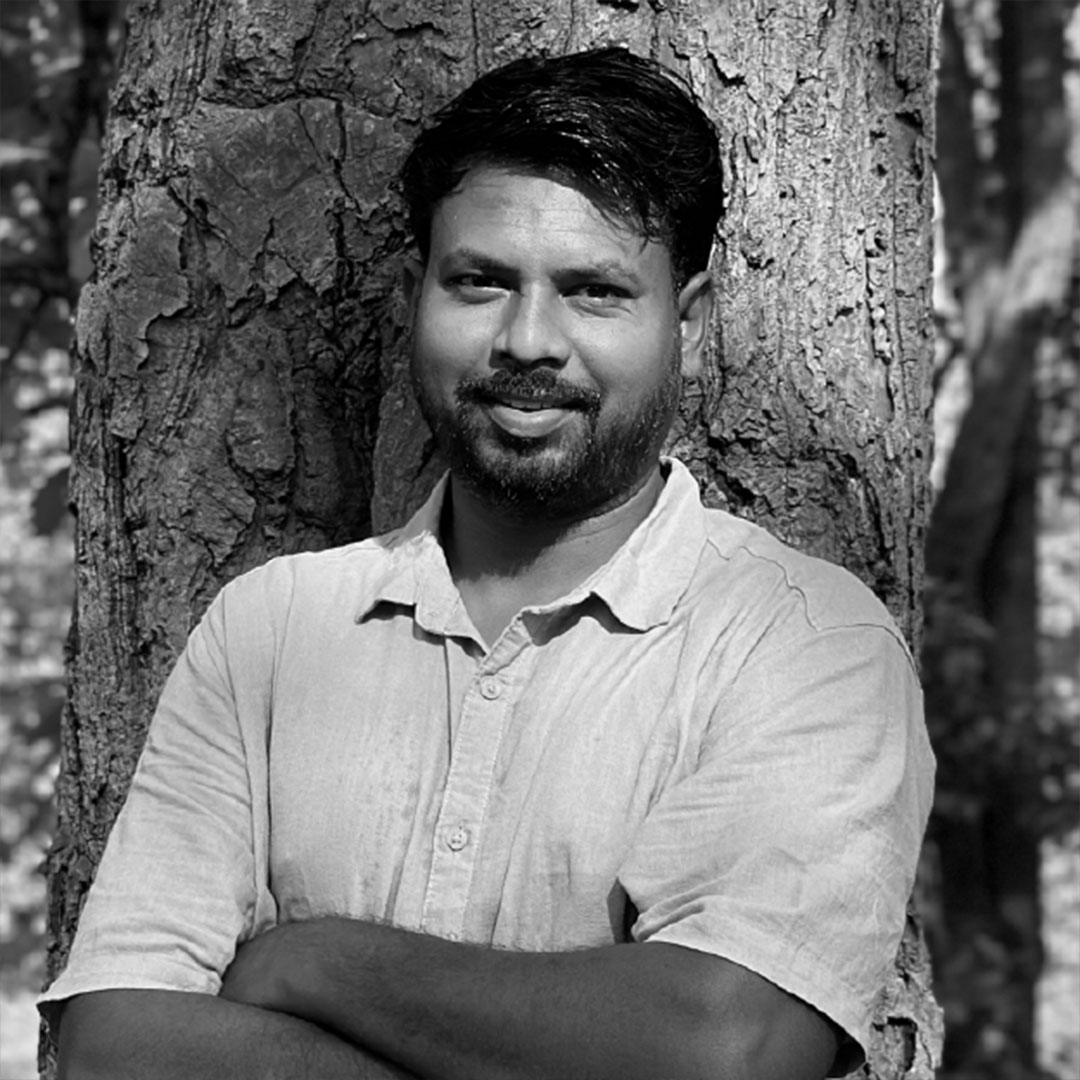

Vankhade Sangam
Vankhade Sangam (b. 1991, India) is a contemporary sculptor whose practice engages deeply with monumental heritage, power structures, and the material memory of stone. Based in Ahmedabad and born into a family of stone carvers, Sangam brings together inherited artisanal knowledge and conceptual inquiry to create works that speak to the lasting imprint of empires—both physical and ideological.
His practice centers on stone carving and drawing, mediums through which he interrogates how architecture, scale, and material embody systems of control, permanence, and erasure. His sculptural forms often evoke fragments of ancient structures, partially erased inscriptions, or reimagined relics—inviting viewers to reflect on the relationship between past civilizations and contemporary identity.
Sangam holds a Master’s degree in Sculpture from the Faculty of Fine Arts, Baroda (MSU), one of India’s leading art institutions. His academic and studio-based training informs a nuanced practice that moves fluidly between personal history and collective memory. While firmly rooted in traditional craft, Sangam’s work is driven by questions of authorship, labor, and the invisible forces that shape cultural monuments.
He has exhibited in both solo and group exhibitions in India, and his work has been featured across multiple editions of the India Art Fair, one of South Asia’s most prominent platforms for contemporary art. His practice continues to evolve through site-responsive projects and residencies that challenge the way we interact with built environments and inherited histories.
With each carved surface and sculpted form, Vankhade Sangam offers a meditation on the permanence of stone and the impermanence of power—charting a quiet, critical path through the echoes of empire and the poetics of place.
Notable Exhibitions
- India Art Fair (New Delhi, India)
- Solo Exhibition: Even Stones Tell Stories (Kanoria Centre for Arts, Ahmedabad, India, 2018)
- Group Exhibition: Unfold Voyage (CIMA Art Gallery, Kolkata, India, 2017)